


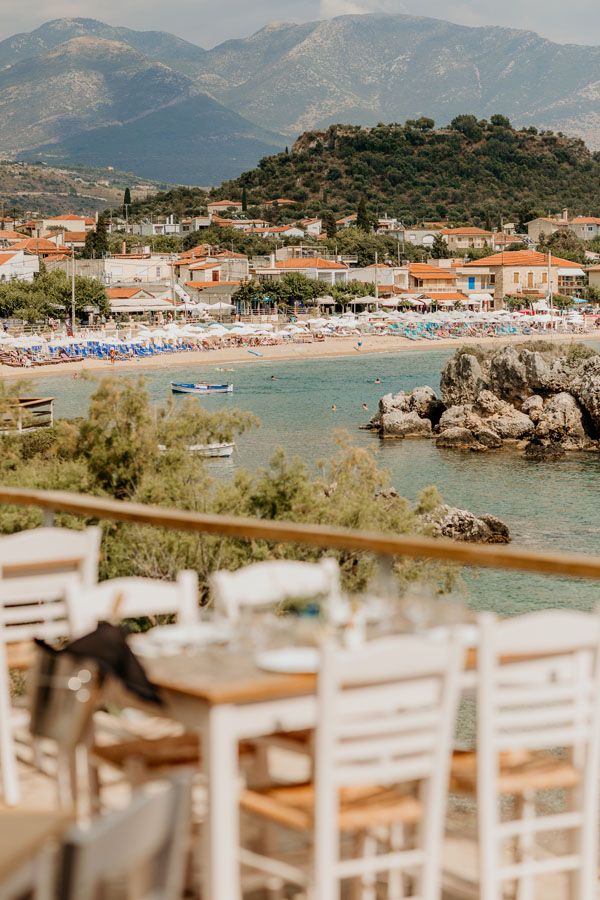
Stoupa has a beach in the middle of the village and several more within a short drive of it. They are not interchangeable. One is fine sand with bars and watersports on it; one is white pebbles at the bottom of a footpath; one you park above and walk down to. Choosing the wrong one for the day you actually have in mind, small children, snorkelling, somewhere quiet, is the mistake most people make here once, and only once.
Key takeaways
- Stoupa beach and Kalogria are the two you walk to: fine sand, tavernas, watersports and easy swimming for families.
- Foneas (4 km from Kardamyli toward Stoupa) is white pebbles below the road with one huge rock; Delfinia is the sheltered cove between the villages.
- Pantazi, also called Platia Ammos, is sand and pebbles south near Agios Nikolaos with a canteen, a small tavern and parking.
- Ritsa is Kardamyli’s long pebble beach, about 600 m from the village centre, where the Viros Gorge meets the sea.
- Choose by the day: sand and facilities for children, Ritsa for depth and snorkelling, Foneas for scenery.
- Every beach here faces west, so the day ends with the sunset over the gulf, best watched from Enigma’s terrace.
Here is what is on this stretch of coast, how far each beach is, and what you will find when you get there.
Stoupa and Kalogria: the two you can walk to
Stoupa sits in the municipal unit of Lefktro, in the municipality of West Mani, Messenia. This is the part of the peninsula that British and German travel writing calls Outer Mani or Messenian Mani, Kardamyli, Stoupa and Agios Nikolaos are its three coastal anchors, and Kardamyli is its most important settlement. The 2021 census recorded 638 permanent residents in Stoupa. The village has two beaches, and both are in it.
Stoupa beach is the sandy one in the middle of the village, the one people mean when they say “the beach”. It is commonly described as the best sandy beach in Outer Mani, and like Kalogria it is fed by underground freshwater springs.
Kalogria is roughly half a kilometre from Stoupa, 6.5 km from Kardamyli and 40 km from Kalamata. Fine white sand, water that is clear and shallow but noticeably cold, the springs feeding it carry water off Mount Taygetos and push it up through the seabed, which is also what keeps it clean. If you swim through a cold patch in August, that is what you have found. It is the organised beach of the two: taverns and bars, watersports, sea bikes and canoes for hire.
Kalogria is also the literary one, and not loosely, locally it is simply called Zorba’s beach. Nikos Kazantzakis and Giorgos Zorbas lived here between 1917 and 1919, and this is where Kazantzakis wrote the novel that became Zorba the Greek; his protagonist was based on a real acquaintance from Stoupa. The house the two men lived in stood at the northern end of the beach. At the southern end is the cave Kazantzakis used as a place to read and write, which you can only reach by swimming or by boat. A bust of him looks out over the sand. The full version of that story is in our piece on the real Zorba and Kazantzakis in Stoupa.
Foneas: white pebbles and one very large rock
Foneas is 4 km from Kardamyli centre in the direction of Stoupa, the first beach you meet on that road coming out of Kardamyli.
It is not a sand beach. Foneas is white pebbles, enclosed by tall rocks, and split in two by a single colossal rock standing in the bay. You reach it at the end of a path, by a short descent from the road, and there is a canteen there for snacks and cold drinks. The name, locally, is put down to a pirate who was shipwrecked there and took refuge in its cave.
The rock is why people come, and it is also the reason to think twice with young children: this is a steep-sided cove with a path down into it, not a beach you walk onto from a car park.
Delfinia: the cove between the two villages
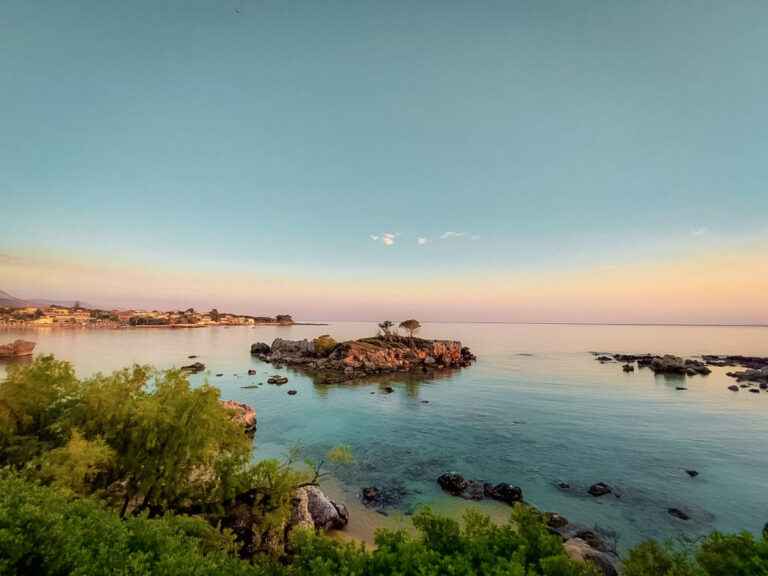
Delfinia is 5 km from Kardamyli centre towards Stoupa, in a sheltered bay between the two, closed in by steep cliffs covered with olives, pines and cypresses.
The beach runs about 170 metres: dark pebbles and sand, calm water. You park above it, off the road, at the top of the track, and walk down; there is a café at the beach entrance and a small snack bar. It stays quieter than Kalogria for a simple structural reason: you cannot drive onto it, so it never fills the way an open beach does.
There is a cave here too, Polyora, with stalactites and a small sand beach inside it, reachable only by swimming.
Pantazi: sand, pebbles and a tavern to the south
Pantazi, also known as Platia Ammos, lies between the villages of Agios Dimitrios and Agios Nikolaos, 2 km from Agios Nikolaos. Agios Nikolaos itself is a fishing village on the eastern shore of the Messenian Gulf, about 4 km south of Stoupa and around 30 km south-east of Kalamata. It had 425 residents at the 2021 census, and there are Byzantine churches in the hills above it, which makes the trip south worth more than the swim on its own.
Pantazi is sand and pebbles together, and it manages to be organised and quiet at once: a canteen serving coffee and soft drinks, a small tavern at the right-hand end of the beach, and a parking lot. Of everything on this list, it is the one that gives you facilities without giving you a crowd.
Ritsa: Kardamyli’s long pebble beach, where the gorge comes out
Ritsa is at the entrance of Kardamyli, about 600 m from the village centre and 38 km from Kalamata. You turn downhill off the main road on the right as you come into the village.
It runs for roughly a kilometre. Coarse white pebbles, clear blue water that deepens sharply, which makes it a poor choice for toddlers and a good one for snorkelling, since the seabed is worth the mask. A large part of it is organised with umbrellas and sunbeds, and there is parking on the other side of the road.
The Vyros Gorge, one of the finest in Western Mani, runs from the foot of Profitis Ilias down to Kardamyli and terminates at Ritsa. If you walk it, this is where you finish, and the swim at the end is not incidental.
How to choose, and where the day ends
The short version:
Sand, facilities, children: Stoupa beach, or Kalogria half a kilometre away.
Depth and snorkelling: Ritsa, at Kardamyli.
Scenery, and you don’t mind a footpath: Foneas (4 km from Kardamyli) or Delfinia (5 km).
Quiet, with a tavern and a car park: Pantazi, 2 km from Agios Nikolaos.
One practical note that catches people out: only Stoupa and Kalogria are sand. Foneas and Ritsa are pebbles, Delfinia and Pantazi are mixed. Bring something for your feet, and be honest with yourself about the walk down before you carry a cool box to Foneas.
The other thing worth planning is the end of the day. The Messenian Gulf faces west, which means every one of these beaches sits on a coast that gets the sunset over open water. Stoupa is where most people come back to for it.
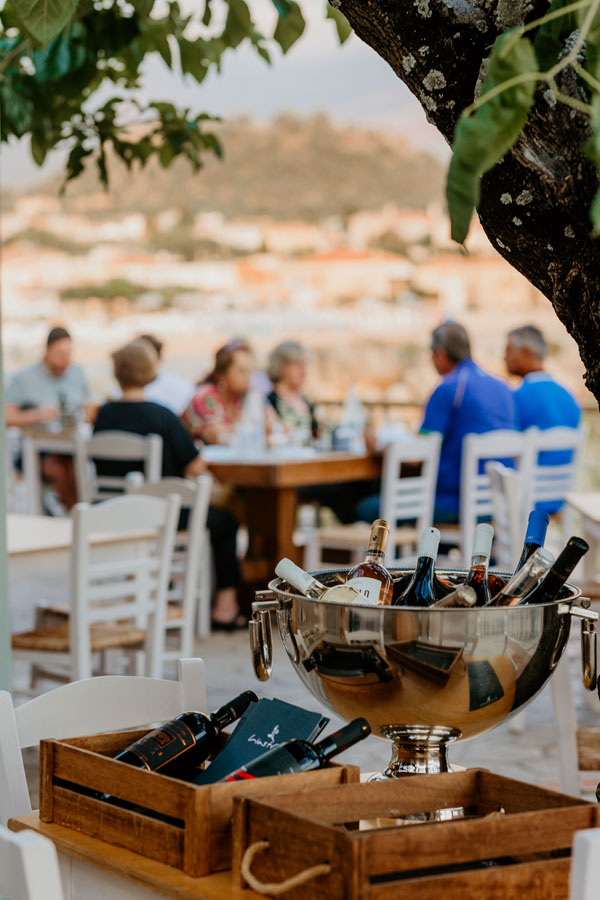
Enigma cafe and cocktail bar in Stoupa is on the beachfront on Tampoureas street, looking straight out over the gulf, built around exactly that hour. Forty metres up the same street, Liastres, traditional Greek restaurant in Stoupa is family-run, with sea and sunset views, local seasonal ingredients and a menu rooted in Mani recipes: slow-cooked meats, fresh seafood, handmade pies, moussaka, stuffed vegetables, salads, vegetarian dishes and local wines.
If this is your first time in the village, the first-timer’s guide to Stoupa covers the rest of it, and you can find both venues on the location page.
Book a table: Liastres, traditional Greek restaurant in Stoupa, reservations by phone only; numbers on the contact page.
Stoupa beach questions people ask
What is Stoupa in Greece like?+
A working village on the Mani coast rather than a resort: a curve of fine sand in the middle, a seafront of tavernas and bars, a second sandy bay called Kalogria half a kilometre north, and pebble coves within a short drive. The mountains of Taygetos rise straight behind it.
Is Kalogria beach in Greece?+
Yes, and there are two. The Kalogria near Stoupa in Messinia is a small sandy bay just north of the village, sheltered and family friendly, and the one this guide describes. There is another Kalogria beach in Achaia, near Patras, which causes confusion in searches.
What is the closest airport to Stoupa beach?+
Kalamata International Airport (KLX), roughly 45 to 55 km by road, around 50 minutes’ drive down the coast. It has direct flights from many European cities from spring to autumn.
How do I get from Kalamata airport to Stoupa?+
By hire car or taxi along the coast road south, about 50 minutes. Taxis from the airport run on published fixed fares for the route; agree the price before you set off. A hire car is worth having, because the best coves are a short drive from the village.
Which is better, Parga or Stoupa?+
Different coasts, different moods. Parga is a busier resort town on the Ionian with island trips. Stoupa is a quieter Mani village with sandy bays, pebble coves and the mountains behind, where evenings are tavernas and sunset drinks rather than nightlife. Choose Stoupa for calm sea, walking and slow evenings.
Are there sunbeds on Stoupa beach?+
Yes, on the village beach and at Kalogria, along with tavernas and watersports. Below the terrace of Enigma on Tampoureas street the venue runs its own stretch with loungers and umbrellas. The pebble coves such as Foneas and Delfinia have nothing added, which is their charm.
Is Stoupa beach good for children?+
Very. The village beach and Kalogria are fine sand with shallow, calm water and facilities within a few steps. Save the pebble coves for older swimmers and snorkelling days, and remember that Foneas has deep water close to shore.
Read next

All journal articles · Enigma & Liastres Stoupa · Book a table