


Most people who look up Zorba the Greek and Stoupa are searching for a film location.
Key takeaways
- The 1964 film Zorba the Greek was shot in Crete, not in Stoupa.
- The story was born here: in 1917 Kazantzakis invested in a small lignite mine at Prastova above the village.
- The real Giorgis Zorbas was the mine foreman. The two men lived at Kalogria beach.
- Zorbas died in Skopje in 1941; the novel was written afterwards from the memory of those two years.
- The Prastova mine is still there, overgrown. Kalogria is the beach where the conversations happened.
- Stoupa has the origin of the story, not a film set.
The answer to that question is: the film was not made here. The 1964 movie, directed by Michael Cacoyannis and starring Anthony Quinn and Alan Bates, was shot entirely in Crete: the city of Chania, the village of Kokkino Chorio in the Apokoronas region, and Stavros Beach on the Akrotiri Peninsula, where Quinn danced the Sirtaki in the scene that made the film famous. There is no Anthony Quinn connection to Stoupa. The beach named after Quinn in Greece is in Rhodes.
But Stoupa has something more significant than a film location. It has the origin of the story itself: the place, the beach, the people, and the failed mining venture that gave Nikos Kazantzakis the material for one of the most widely read Greek novels of the twentieth century.
The film was made in Crete. The story was born in Stoupa. This is the distinction that matters.
The Mine at Prastova and How Zorbas Came to Stoupa
In 1917, a relatively unknown Cretan writer named Nikos Kazantzakis came to Stoupa and invested in a small lignite mining operation. The location was Prastova, a site in the cliffs behind the village. It was wartime, coal supplies were short across Greece, and even the low-grade lignite of the Mani hillside had commercial value.
Kazantzakis needed an experienced miner to run the operation. He recruited Giorgos Zorbas, a man he had encountered during a stay together on Mount Athos. Zorbas was older, physically imposing, experienced in mining, practically skilled in ways that the intellectual Kazantzakis was not, and possessed of a personality that the writer found difficult to categorize and impossible to forget. He played the santuri, danced at any opportunity, approached each day without evident caution, and spoke about life with a directness that Kazantzakis found both unsettling and liberating.
Zorbas came south to Stoupa with his family and took up the role of foreman. The operation began.
Kalogria Beach: Where the Characters Were Formed
The two men lived at Kalogria Beach, the smaller bay immediately north of Stoupa, in simple accommodation on the shoreline. Kazantzakis rented a cottage at the end of the beach and set up a writing space, working through books and ideas while Zorbas managed the mine and the miners.
The days on Kalogria followed a rhythm: work at the mine during the day, evenings on the beach where Zorbas would play music, dance, argue about life, drink, and recount episodes from his extraordinary biography. Kazantzakis listened and, by his own later account, was changed by what he heard.
The mine proved economically unworkable. The galleries were flooded by groundwater that progressively deteriorated the lignite quality until the company dissolved in 1918. The operation was over. Kazantzakis and Zorbas went their separate ways.
The Novel That Came Out of Two Years on the Mani Coast
Twenty-three years passed. Zorbas settled in Skopje, where he died in September 1941. When Kazantzakis received news of his death, he sat down in Aegina and wrote the novel that would make the older man famous across the world: “The Life and Times of Alexis Zorba.”
Kazantzakis transposed the setting to Crete. His reasons are not entirely clear: perhaps to protect people still living, perhaps because Crete was his own homeland and felt like the natural landscape for the story, perhaps for reasons of narrative convenience. But the characters came from Stoupa. The failed mining venture, the beach evenings, the friendship between an inhibited intellectual and a man who could not stop moving: the Mani coast is underneath all of it.
The character’s name was not even changed. Giorgos Zorbas became Alexis Zorba.
In the novel Kazantzakis wrote about what Zorbas represented to him: “In my life, the greatest benefactors have been the travels and the dreams. Of the people, alive and dead, very few helped with my struggle.” Zorbas was one of the few.
What Is Still There to See in Stoupa
The physical traces of 1917 are still accessible to anyone who looks for them.
The Prastova mine above the village is overgrown and the gallery entrances have been sealed off. The narrow-gauge railway that Zorbas built to carry lignite down the cliffs to the loading point at the shore is long gone, but the route it followed is visible in the landscape if you know what you are looking at.
Kalogria Beach looks much as it would have in 1917. The pine trees that come close to the shore, the calm water, the sheltered aspect of the bay: the physical character of the place has not changed substantially.
Above the beach there is a bust of Kazantzakis, placed in his honour at the location where he lived and worked. Visitors who know the story come to find it. Some arrive in Stoupa specifically for this purpose, with a copy of the novel in their bag.
The small house at the end of Kalogria beach where Zorbas lived, rented from a local family named Exarchouleas, has been renovated and is still standing.
Why This Story Matters More Than a Film Set
A film location gives you a backdrop. What Stoupa has is the actual origin of the story: the beach where the conversations happened, the cliffs where the mine was dug, the evenings that Kazantzakis spent listening to a man he could not stop thinking about for the rest of his working life.
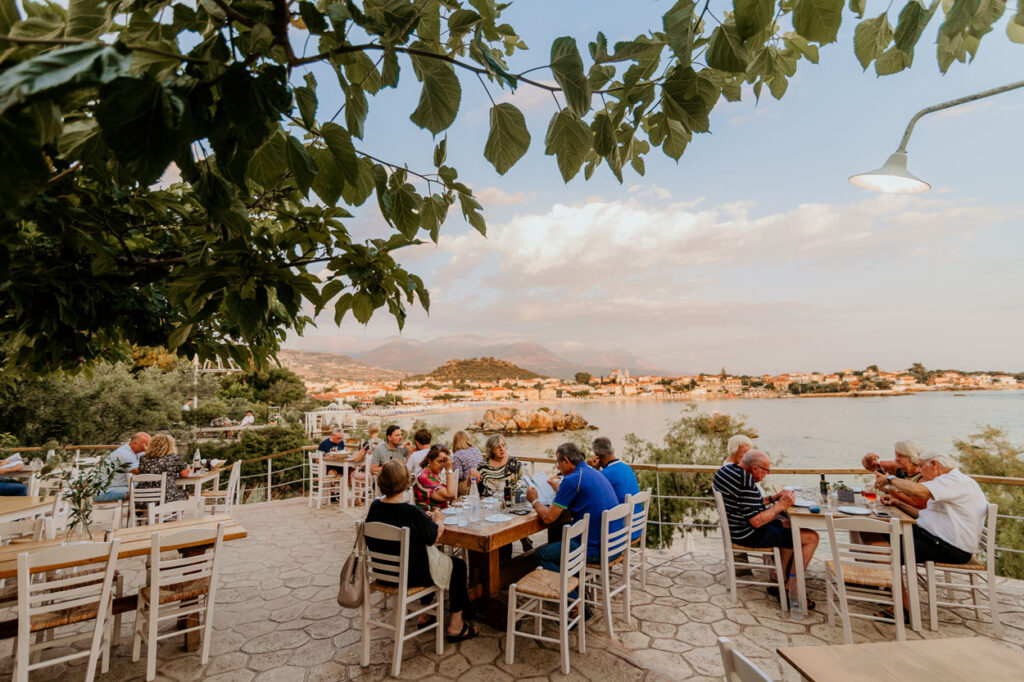
The headland where Enigma cafe and cocktail bar in Stoupa now stands looks directly across the bay toward Kalogria. The same Messenian Bay light that Kazantzakis wrote about in his letters from this coast. The same mountains opposite. The same quality of evening that was there when Zorbas was dancing on the sand below.
If you are sitting at Enigma’s terrace and you know this history, the view acquires a different weight. You are not simply looking at the sea. You are looking at the coastline that produced one of the twentieth century’s most recognized fictional characters.
Read more: The Best Cocktail Bar in Stoupa: Sunset at Enigma.
Read more: A First-Timer’s Guide to Stoupa: Beach, Sunset and Local Flavours.
Also worth reading: Stoupa Beach and Kalogria: Where to Swim on the Mani Coast.
Zorba and Stoupa questions people ask
Was Zorba the Greek filmed in Stoupa?+
No. The 1964 film directed by Michael Cacoyannis, with Anthony Quinn and Alan Bates, was shot entirely in Crete. What Stoupa has is the origin of the story: in 1917 Nikos Kazantzakis and the real Giorgis Zorbas lived here while running a lignite mine above the village.
Where in Crete was Zorba filmed?+
Mainly on the Akrotiri peninsula near Chania, including the beach at Stavros where the famous dance scene was shot. Kazantzakis moved the novel’s setting to his native Crete, which is why the film went there, but the events behind the book happened on the Mani coast at Stoupa.
Was Zorba a real person?+
Yes. Giorgis Zorbas was a miner and foreman from Macedonia whom Kazantzakis hired in 1917 to run a small lignite mine at Prastova above Stoupa. The two men lived at Kalogria beach for about two years. Zorbas later settled in Skopje, where he died in September 1941.
What does Zorba mean in English?+
Zorbas is simply the man’s surname; it is not a Greek word with a meaning. Through the novel and the film it became shorthand for a certain Greek appetite for life: dancing, eating, drinking and living in the moment, the character Kazantzakis built from the real foreman he knew in Stoupa.
What is the message of Zorba the Greek?+
The book sets the narrator, a bookish intellectual, against Zorba, who lives through his body and his instincts, and asks which of them understands life. The two years at the Stoupa mine, where the business failed and the friendship did not, are where Kazantzakis learned the question.
What is still there to see in Stoupa from the Zorba story?+
The Prastova mine above the village, overgrown but findable, with the gallery entrances still visible; Kalogria beach, where the two men lived and talked; and the cliffs and coast they walked. It is a landscape rather than a museum, best explored on foot from the village.
Where is the best place to end a Zorba day in Stoupa?+
Back at the water. Kalogria is a short walk north of the village for a swim where the story was formed, and Tampoureas Street on the headland has Enigma for a sunset drink and Liastres for a Mani dinner, the kind of table Zorba would have approved of.
Read next
All journal articles · Enigma & Liastres Stoupa · Book a table