


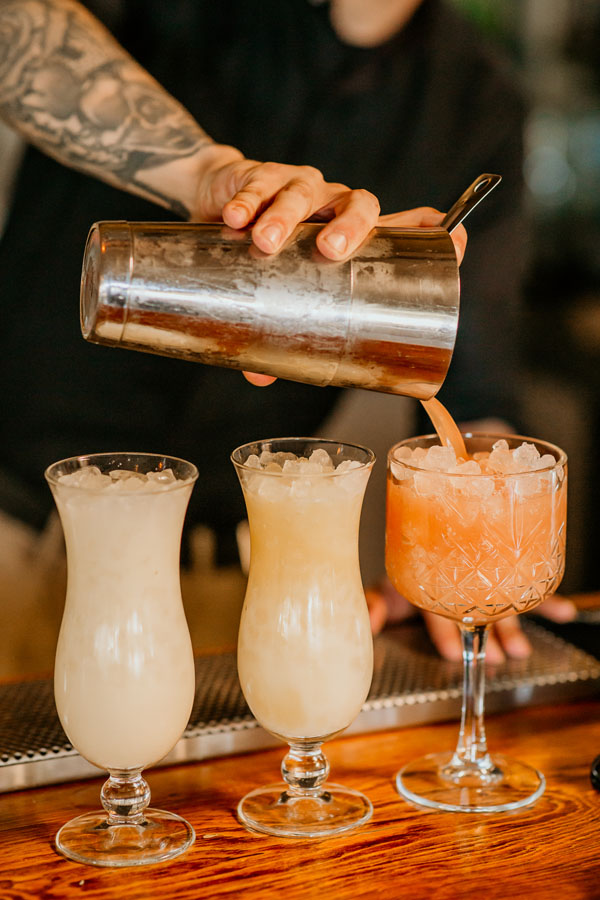
Most people in Stoupa watch the sunset by accident. They are halfway through dinner, or still on the beach shaking sand out of a towel, and the light goes while they are looking at something else.
Key takeaways
- Sunset in Stoupa is an appointment that moves: around 20:54 in late June, 20:17 in late August, 19:32 in late September.
- Greece has three native spirits worth knowing: tsipouro from grape pomace, ouzo with anise (protected since 2006) and mastiha from Chios.
- The Messinian pantry adds the other half: oranges, lemons and mandarins from the plain, mountain tea and herbs from Taygetos.
- Judge a bar by ice, glassware and technique: citrus, egg or dairy get shaken, spirit-forward drinks get stirred.
- Enigma on Tampoureas street looks west over the Messenian Gulf, exactly where the sun goes down.
- Order before the rush: at 20:15 in August forty people want the same drink at the same minute.
The sunset here is not a vague evening mood. It happens at a specific minute, in a specific direction, and it finishes faster than most visitors expect. If the plan is to have something decent in your hand while it happens, both halves of that sentence need a little thought, the timing, and the drink.
Here is the timing, the geography that makes this particular coast work, and what is actually in a Greek cocktail.
The sunset is an appointment, and it moves
Stoupa sits at roughly 36.85°N. That fixes the arithmetic. Sunset and end of usable light, in local time:
| Date | Sun sets | Dark by |
|---|---|---|
| 21 June | 20:54 | 21:24 |
| 20 July | 20:48 | 21:17 |
| 20 August | 20:17 | 20:43 |
| 20 September | 19:32 | 19:57 |
| 20 October | 18:49 | 19:14 |
Two things fall out of that table.
First, between late June and late September the sun goes down more than an hour and twenty minutes earlier. A September table booked on a July instinct arrives to find the show already over. This is the single most common way to miss it.
Second, the window is short. Civil twilight ends 25 to 30 minutes after the sun clears the horizon, after that you are sitting in the dark holding a drink, which is a fine way to spend an evening but is not the thing you came for.
The part worth being seated for is the hour before the number in that table, not the minute of it. The light on the water does its work on the approach. Arrive 45 minutes to an hour early, order then, and you have covered both the good light and the queue that forms at exactly the wrong moment.
The other half of the arithmetic is direction, because not every seaside village gets a sunset over water at all. Plenty of Greek coastline faces east and gets a nice pink wall of rock instead. Stoupa is on the western shore of the Mani peninsula, which is the same thing as the eastern shore of the Messenian Gulf. The gulf’s eastern side is backed by the southern foothills of Taygetos, the mountain is behind the village, not in front of it. West of Stoupa there is open water until the Messenian shore, roughly 30 kilometres across. Nothing stands between the village and the horizon.
The setting point also travels along that horizon. At the June solstice the sun goes down at an azimuth of about 300°, northwest, up the open gulf in the general direction of Kalamata. By the equinox in late September it sets at 270°, due west, across the gulf toward the far Messenian shore. That is around thirty degrees of horizon over a single season. Take the same seat in June and again in September and you are, in a real sense, watching two different views.
The Greek spirits worth knowing
Greece has three native spirits that turn up behind almost every bar in the country. None of them are novelties, and all three are legally defined rather than merely traditional.
Mastiha is made from the resin of the mastic tree. The tree grows around the Mediterranean, but only Chios mastiha carries EU Protected Designation of Origin status, the same class of protection as Champagne or Parmigiano-Reggiano. It tastes of pine and eucalyptus with bay leaf and mint behind it, piquant at first and sweet on the finish. Bartenders tend to push it toward citrus, mint or tonic, because it needs something to argue with.
Tsipouro is distilled from grape pomace: the skins and stems left after the wine is made. It runs 40-45% ABV and comes plain or flavoured with anise and fennel. Under EU rules it must be distilled in Greece from Greek grapes. It started in the monasteries of Mount Athos in the 14th century, initially as medicine, and spread from there, a drink invented because throwing away the leftovers was unthinkable.
Ouzo is the anise one, protected since 2006, and only Greece and Cyprus may use the name. The rules are specific: at least 20% of the alcohol must come from a distillate of aniseed, optionally with fennel, star anise, coriander or Chios mastic alongside, and anise has to stay dominant. That is not a style guideline, it is the legal definition.
None of these are easy cocktail ingredients. Resin and anise are loud, and they do not politely recede behind gin. Athens is largely where that problem got solved: The Clumsies has been in the World’s 50 Best Bars every year since 2015, and Line came in at number eight in 2025, both built partly on Greek ingredients used seriously rather than as a novelty. That is the national context. What any individual bar does with it is a question for whoever is standing behind it, so ask.
What the Messinian pantry adds
The other half of a Greek drink is not distilled at all.
Citrus grows on the Messinian plain in quantity, oranges, lemons, mandarins, which matters more than it sounds, because fresh citrus is the difference between a cocktail and a soft drink with a kick.
Honey from the Taygetos slopes comes in several forms depending on what the bees found: thyme, sage, fir, pine. Honey is a sweetener that brings its own flavour, which makes it either an asset or a complication, depending on who is using it.
Sideritis, Greek mountain tea, grows on Taygetos between roughly 1,300 and 2,000 metres and is naturally caffeine-free. It is a herb with a genuine local address, which is more than most bar syrups can say.
And there is wine. Messinia has been a PGI zone since 1989, with Roditis, Fileri, Assyrtiko, Moschofilero and Agiorgitiko among the varieties grown, PGI rather than PDO, since the region has no PDO appellations of its own.
How to judge a bar in one drink
You can tell a good cocktail bar from a fast one without knowing anything about mixology. Three things do most of the work.
Ice. Size and clarity determine how quickly it melts, and melt rate is dilution. Large or clear ice chills slowly and keeps the drink where the bartender intended; small cloudy ice chills fast and waters it down. If the ice looks like it came out of a bag, expect the drink to fade.
Fresh citrus. Squeezed to order tastes clean and slightly aggressive. Bottled tastes flat and vaguely sweet. This is the easiest thing in the world to notice once you have noticed it once.
Balance. A cocktail is a negotiation between sweetness, acidity, bitterness, strength and texture. If one of them is shouting, the drink is out. There is also a tell in the technique: anything with citrus, egg or dairy should be shaken, anything spirit-forward should be stirred. A stirred sour is a bar in a hurry.
A drink is only as good as its weakest link. In a village bar in August, at 20:15, with forty people wanting the same thing at the same minute, the weakest link is usually time, which is the practical reason to order before the rush rather than during it.
Where this happens in Stoupa
Enigma cafe and cocktail bar in Stoupa sits on Tampoureas Street, on the headland at the edge of the bay, looking west over the Messenian Gulf, which, per the geography above, is the direction that matters. Its own page describes a day that starts with coffee and espresso and ends with cocktails, local wine and light bites, with the sunset over Stoupa beach in between.
Forty metres down the same street, Liastres, traditional Greek restaurant in Stoupa handles dinner, same family, Mani cooking. Drink first, eat after, or the reverse; the walk is under a minute either way. How the two ended up on the same headland is covered in the story behind Enigma and Liastres, and where Stoupa sits on the map covers getting here.
Tables are booked by phone, personally, no app, no platform, no automated anything. The full picture of how reservations work explains when it is worth calling ahead and when you can walk in, and the numbers are on the contact page. For the venue’s own case, the hours, the happy hour, the beach below the terrace, there is a separate piece on the best cocktail bar in Stoupa.
A short honest note
There is no cocktail list printed in this article, and that is deliberate.
Menus in a village this size move with the season and with what arrived that week. What is on the board in May is not what is on it in August, and a list published here in July would be quietly wrong by September. The useful move is the old one: ask what they are making tonight, say what you like, and let the person holding the shaker decide. In a bar this size that person usually invented the drink, and would rather tell you what is good today than sell you something printed last year.
Arrive an hour before the number in the table. The rest sorts itself out.
Sunset table: Enigma cafe and cocktail bar in Stoupa, reservations by phone; numbers on the contact page.
Greek spirits and sunset questions people ask
What is the most popular Greek spirit?+
Ouzo is the most famous abroad, but in Greece itself tsipouro is at least as widely drunk, especially on the mainland and in the Peloponnese. Mastiha from Chios is the third native spirit and the one bartenders reach for most in modern cocktails.
What are the Greek spirits?+
Three native ones turn up behind almost every bar: tsipouro, distilled from the grape skins and stems left after winemaking; ouzo, neutral alcohol flavoured with anise, a protected name since 2006 that only Greece and Cyprus may use; and mastiha, a liqueur made with the resin of the mastic tree of Chios. Raki or tsikoudia is Crete’s version of tsipouro.
What is in a sunset cocktail?+
There is no single recipe; the name describes the hour, not the glass. On this coast the natural version is a Greek spirit, usually mastiha or tsipouro, with Messinian citrus and something herbal from the mountain, built long over good ice so it lasts the twenty minutes the light takes to change.
What time is sunset in Stoupa?+
It moves through the season: roughly 20:54 on 21 June, 20:48 on 20 July, 20:17 on 20 August, 19:32 on 20 September and 18:49 on 20 October, with usable light for about half an hour after. Sit down twenty minutes before those times rather than after.
What is the best sunset spot in Stoupa?+
The headland on the right hand side of the bay, where Tampoureas street runs. Enigma’s terrace sits on it looking west over the Messenian Gulf, which is the direction the sun sets in from May to September, over open water toward the Messinian coast.
What is the strongest Greek alcohol?+
Village-distilled tsipouro and Cretan raki can reach 45 percent or more, above most commercial ouzo at 37.5 to 40 percent. Whatever the number, Greeks drink all of them slowly, cold and with food, which is why they rarely feel as strong as the label suggests.
Should you mix ouzo with water?+
Yes, that is the traditional way: a little cold water or ice turns it milky and softens the anise. Plain tsipouro is different; water only dilutes it, so it is drunk neat or over a cube of ice, always with meze.
Read next
All journal articles · Enigma & Liastres Stoupa · Book a table
2 Comments
[…] Also worth reading: Sunset Cocktails in Stoupa: Greek Spirits and the Right Hour. […]
[…] you are staying a while, our guide to sunset cocktails and Greek spirits covers what comes after the coffee, and the guide to Mani cuisine covers what to eat in […]