


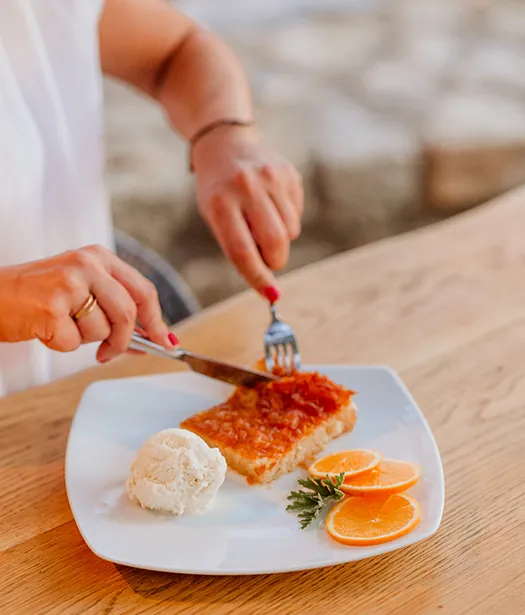
Greek desserts come from a short list of ingredients that the country has always had in abundance: honey, walnuts and almonds, olive oil, semolina, citrus, sesame and the thin phyllo dough that turns all of them into pastry. Put together in different ways, those ingredients give you syrup soaked trays of baklava, hot loukoumades in honey, fruit preserved in syrup and the cookies that fill every kitchen at Christmas. This guide explains the main families of Greek sweets, what each one is made of, where it comes from when the history is clear, and what to look for in the Mani and Messinia. In Stoupa, the easiest way to start is a Greek coffee and something sweet on the terrace of Enigma cafe and cocktail bar in the afternoon.
Key takeaways
- Most Greek desserts are built on honey, nuts, olive oil, semolina, citrus and phyllo dough.
- Syrup soaked sweets (siropiasta) include baklava, galaktoboureko, kataifi, portokalopita, revani and karydopita.
- Loukoumades are fried balls of yeast dough soaked in honey, the Greek answer to donuts; bougatsa is phyllo with cream.
- Spoon sweets are fruit preserved in thick syrup, served on a small spoon with a glass of cold water.
- Christmas means melomakarona and kourabiedes; in the Peloponnese and the Mani, diples are made for weddings and holidays.
- In Stoupa, take a coffee and a sweet at Enigma in the afternoon, or finish dinner at Liastres and walk 40 metres to Enigma.
What makes a Greek dessert Greek
Three ideas run through almost every traditional Greek sweet. The first is syrup. A large share of Greek desserts are baked first and then soaked in a syrup of sugar or honey and water, often flavoured with lemon peel, cinnamon or clove. Greeks call this family siropiasta, the syruped ones, and the old kitchen rule is that one of the two must be cold when they meet: hot syrup goes on a cooled cake, or cool syrup goes on a cake straight from the oven, so it soaks in without turning soggy. The second idea is phyllo, the paper thin sheets of dough that are layered, rolled or shredded. The third is nuts and spice, usually walnuts with cinnamon and clove, sometimes almonds or sesame.
Many of these sweets are shared with Turkey, the Balkans and the Middle East, a result of centuries of trade and of the Ottoman period, and the names often show it. What changes from place to place is the detail: honey rather than sugar syrup, walnuts rather than pistachios, olive oil rather than butter in the sweets made for fasting periods.
Syrup soaked sweets: baklava, galaktoboureko and the tray family
These are the sweets you will see in the window of every zacharoplasteio, the Greek pastry shop, cut into squares or diamonds and glistening with syrup.
- Baklava: many sheets of phyllo brushed with butter, layered with chopped walnuts (sometimes mixed with almonds), cinnamon and clove, cut into diamonds before baking and soaked in honey syrup. Good baklava is crisp on top and moist underneath, never chewy.
- Galaktoboureko: a thick custard of semolina, milk and eggs baked between layers of phyllo, then soaked in a lemony syrup. The name joins the Greek word for milk, gala, with the Turkish word for a filled pastry. It is at its best on the day it is made, still slightly warm.
- Kataifi: the same dough shredded into fine threads, rolled around a filling of walnuts or almonds, baked and syruped. Ekmek kataifi is a richer cousin, a kataifi base with a layer of custard and whipped cream on top.
- Portokalopita: orange cake made not with flour but with dried, torn phyllo, mixed with yoghurt, eggs, oil and orange zest and juice, then soaked in orange syrup. A good use for the oranges of the Peloponnese.
- Revani: a light semolina cake, often made with yoghurt, soaked in syrup. The town of Veria in northern Greece is particularly known for it.
- Karydopita: walnut cake, dense with ground walnuts, cinnamon and clove, sometimes made with breadcrumbs or rusks in place of flour, and soaked in syrup. A natural fit for walnut country like the Mani.
As for the old argument over baklava, the honest answer is that it belongs to more than one people. Sweets of dough, nuts and honey existed in Byzantine and older Greek cooking, and the many layered baklava we know today took its shape in the palace kitchens of Ottoman Istanbul. Greek baklava tends towards walnuts and honey, Turkish baklava towards pistachios and sugar syrup. Both are worth eating.
Fried and street sweets: loukoumades and bougatsa
Loukoumades are the Greek sweet most visitors fall for first. A loose, sticky batter of flour, yeast and water is left to rise until it bubbles, then dropped by the spoonful into hot oil, where each piece puffs into a golden ball, crisp outside and airy inside. They are drained, drenched in warm honey or honey syrup, and finished with cinnamon and chopped walnuts or sesame. English menus sometimes call them Greek donuts or baby donuts. The name comes from the Turkish lokma, from an Arabic word meaning a mouthful, and similar fried dough balls exist across the eastern Mediterranean. Loukoumades shops today also offer chocolate, praline or ice cream toppings, but the classic honey version is still the one to try first. Eat them as soon as they arrive; they lose their crunch within minutes.
Bougatsa is a pie of buttered phyllo wrapped around a semolina cream, baked until crisp, cut into squares and showered with icing sugar and cinnamon. Savoury versions with cheese or minced meat also exist. It is a Thessaloniki institution, and its fame there is usually traced to refugees from Constantinople and Asia Minor who settled in the city in the 1920s. Serres, further north, has its own well known style.
Spoon sweets and the submarine
Glyka tou koutaliou, spoon sweets, are pieces of fruit cooked slowly in thick syrup until they are glossy and almost translucent, then kept in jars for the whole year. Sour cherry, quince, fig, grape, bitter orange and bergamot are the classics; green walnuts, picked before the shell forms, are a speciality, and some households even preserve baby aubergines or small tomatoes. A spoon sweet is the traditional welcome in a Greek home: a single spoonful on a small saucer, a glass of cold water beside it, and often a Greek coffee to follow. You eat the sweet, drink the water, and the visit has properly begun.
The vanilia ypovrychio, vanilla submarine, is the old kafeneio version of the same idea. A spoonful of thick white fondant, flavoured with vanilla or mastic, is plunged into a tall glass of iced water. You lick it slowly as it softens, and the water, slightly sweet by the end, is drunk last. It is a childhood memory for most Greeks and still a good thing to order on a hot afternoon.
Festive sweets: melomakarona, kourabiedes and diples
Greek holidays have their own sweets, and some of them are only made at one time of year.
- Melomakarona: soft oval cookies made with olive oil, orange juice, cinnamon and clove, dipped in honey syrup after baking and topped with chopped walnuts. Because they contain no butter or eggs, they suit the fasting period before Christmas.
- Kourabiedes: rich butter cookies with toasted almonds, buried under a thick layer of icing sugar. They are the other half of the Greek Christmas plate and also appear at weddings and name days.
- Diples: thin sheets of egg dough rolled out by hand, fried in strips, bows or spirals, then drizzled with honey syrup and sprinkled with walnuts and cinnamon. They are a sweet of the Peloponnese above all, made for weddings, christenings, Christmas and New Year.
- Vasilopita: the New Year cake or bread with a coin hidden inside. Whoever finds the coin in their slice is said to have luck for the year.
The Mani and Messinia: diples, lalagia, honey, figs and oranges
The Mani has always cooked with what the land gives, and its sweets follow the same rule. Diples are part of every important family occasion here, and they are made with real patience: the dough is rolled until you can almost see through it, and the frying takes two people. Lalagia, the Mani fried dough, are a close relative. Strips of dough are shaped and fried in olive oil, then eaten plain as a meze or with a drizzle of honey as something sweet. Our guide to Mani cuisine covers them alongside the rest of the local table.
The ingredients around Stoupa explain the rest. Thyme honey from the slopes of Taygetos is thick and aromatic, and it is what goes on the loukoumades and diples. Walnuts come from the villages higher up. Messinia has a long tradition of dried figs, often sold as Kalamata figs, and the plains of Messinia and neighbouring Laconia are full of orange groves, which is why portokalopita and orange spoon sweets feel so at home here. A plate of Greek yoghurt with local honey and walnuts is the simplest Mani dessert of all, and one of the best.
Where to eat something sweet in Stoupa
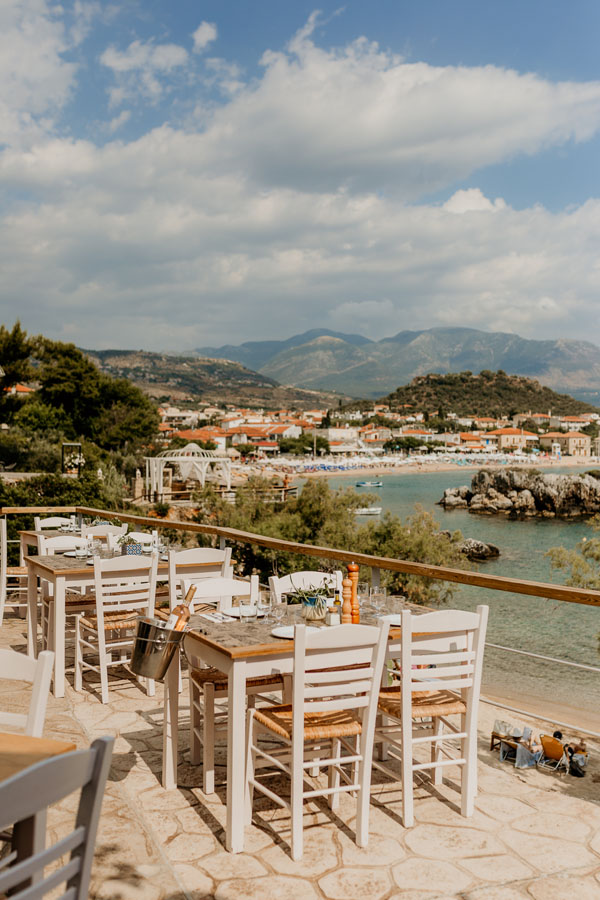
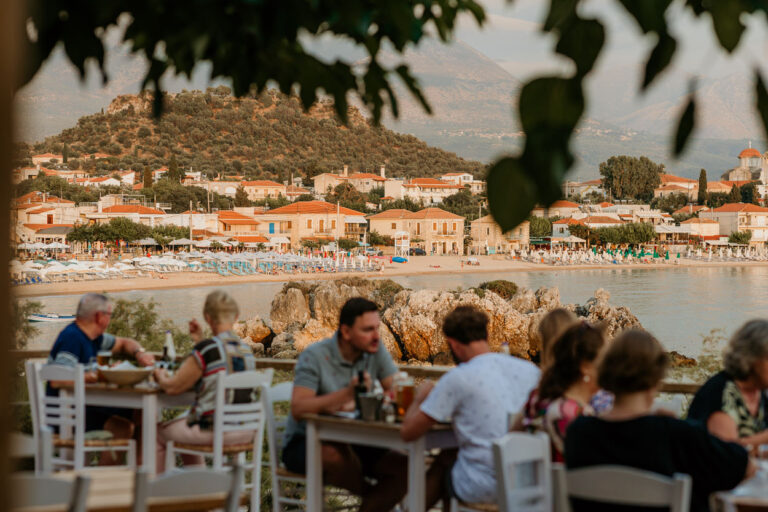
Enigma, the cafe and cocktail bar on Tampoureas street, opens at midday and serves coffee, drinks and sweets through the day, with its sweets grouped under what it calls Sweet Temptations. A Greek coffee or a freddo with something sweet on the terrace in the afternoon is the easy Stoupa ritual, and our guide to Greek coffee explains how to order it. From the afternoon the same terrace turns to cocktails, with the sun setting over the gulf; the guide to sunset cocktails and Greek spirits covers that part of the day.
Liastres, the traditional Mani restaurant 40 metres along the same street, serves lunch and dinner from Mani recipes, with local wines and spirits. A good evening in Stoupa is to finish dinner at Liastres, perhaps with a small glass of aged tsipouro as our tsipouro and meze guide suggests, and then walk the 40 metres to Enigma for coffee and something sweet, or a last cocktail.
Practical notes
- Syrup soaked sweets are best at room temperature; galaktoboureko is best on the day it is made.
- Loukoumades should arrive hot. Eat them straight away, before the honey softens the crust.
- A spoon sweet is eaten in one spoonful, followed by the glass of water.
- Melomakarona and kourabiedes are Christmas sweets; outside December you will mostly find them in pastry shops.
- Local things to look for in Messinia and the Mani: thyme honey, walnuts, dried figs, oranges, diples and lalagia.
- In Stoupa: Enigma for coffee and sweets from midday and cocktails at sunset, Liastres for lunch and dinner. Book a table for sunset in July and August.
Greek dessert questions people ask
What is a traditional Greek pastry?+
The best known traditional Greek pastries are built on phyllo, the paper thin dough that Greek cooks layer with butter or olive oil. Baklava layers it with chopped walnuts and soaks it in honey syrup, galaktoboureko wraps it around a semolina custard, and bougatsa folds it over cream and finishes it with icing sugar and cinnamon. Kataifi uses the same dough shredded into fine threads and rolled around nuts.
Is baklava Greek or Turkish?+
Both countries claim it, and both have a fair case. Layered sweets of dough, nuts and honey existed in the Byzantine and older Greek world, while the modern baklava of many paper thin sheets was refined in the Ottoman palace kitchens of Istanbul, where cooks of many backgrounds worked. Greek baklava usually uses walnuts, cinnamon and a honey syrup; Turkish baklava often uses pistachios and a sugar syrup.
What are popular Greek desserts?+
The ones you will meet everywhere are baklava, galaktoboureko, kataifi, loukoumades, bougatsa, portokalopita (orange phyllo cake), revani (semolina cake) and karydopita (walnut cake). Greek yoghurt with honey and walnuts is the simplest and most common. Spoon sweets, fruit preserved in thick syrup, are offered to guests at home, and at Christmas every household makes melomakarona and kourabiedes.
What is a famous dessert in Greece?+
Baklava is the most famous abroad, but inside Greece loukoumades probably have the widest following: small balls of yeasted dough fried until golden and soaked in honey or syrup, then finished with cinnamon and walnuts or sesame. Galaktoboureko, a semolina custard baked in phyllo and soaked in syrup, is the other dessert most Greeks name when asked for a favourite.
How do you say donuts in Greek?+
The American ring doughnut is simply called donat (ντόνατ) in Greek, borrowed from English, and you will see it written that way in bakeries. The traditional Greek equivalent is the loukoumas (λουκουμάς), plural loukoumades (λουκουμάδες): a small round puff of fried yeast dough with no hole, served hot with honey. If a Greek talks about donuts at a fair or a festival, they usually mean loukoumades.
What are Greek baby donuts?+
Greek baby donuts is the name English menus often give to loukoumades. They are bite sized balls of a loose yeast batter, dropped into hot oil, fried until crisp and golden outside and airy inside, then drenched in warm honey or honey syrup and finished with cinnamon and chopped walnuts. The name comes from the Turkish lokma, from an Arabic word meaning a mouthful. Eat them hot.
How to make loukoumades at home?+
Mix about 250 g flour with 7 g dried yeast, a teaspoon of sugar, a pinch of salt and roughly 250 ml warm water into a loose, sticky batter. Cover it and leave it for about an hour until it doubles and bubbles. Heat sunflower oil to around 175 to 180 degrees, drop in small spoonfuls with a wet spoon, fry until golden, drain, then pour over warm honey and add cinnamon and walnuts.
Read next
All journal articles · Enigma & Liastres Stoupa · Book a table