


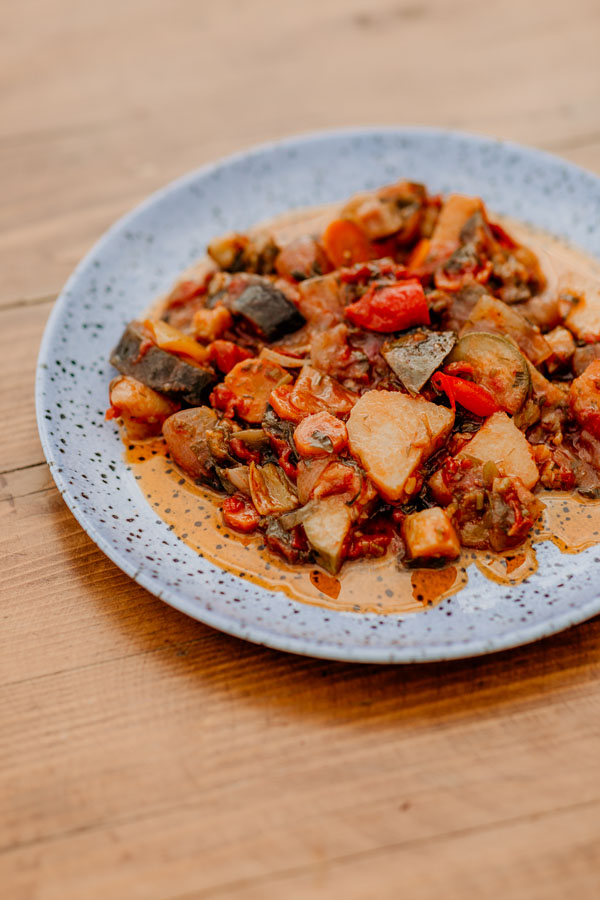
Mani does not cook like the rest of Greece. The peninsula is dry, rocky and steep, and for centuries it was poor and cut off from everywhere else. That shaped a kitchen built on what survives here: pork preserved in its own fat, olive oil, oranges, wild greens picked off the hillsides, and honey. Come to Stoupa expecting only moussaka and grilled fish and you will eat perfectly well, but you will miss the food that actually belongs to this coast.
Key takeaways
- Mani cooks with what survives a dry, rocky peninsula: pork preserved in its own fat, olive oil, oranges, wild greens and brined cheese.
- Syglino is the dish the Mani is known for: salted pork kept in its fat and smoked over mountain herbs, often with orange.
- Lalagia are strips of dough fried in olive oil, tied to holidays and celebrations across both sides of the peninsula.
- Horta, wild greens, are a course here, not a garnish; sfela is Messinia’s own protected-origin brined cheese.
- Olive oil, olives and oranges are the backbone that shows up in almost every dish.
- Liastres on Tampoureas street cooks the Mani side of the menu with local, seasonal ingredients; not every dish is on every menu every night.
Here is what to look for, and what it is.
Syglino: the dish Mani is known for
If you order one thing on this peninsula, order syglino.
Syglino is salted pork kept inside its own fat, glina, which is where the name comes from: sin + glina. The pork is smoked over local aromatic herbs, then simmered in water with oranges, and finally packed into jars under olive oil. Before refrigeration this was how a family made a pig last through winter. It stayed because it tastes extraordinary.
You will meet it in three ways: on its own as a starter, cut into a salad with oranges, or fried into eggs. It is dense, smoky, faintly citrus, and salty in the way good cured meat is salty. It is not a light dish. It is not trying to be.
Lalangia: the fried bread of every Mani holiday
Lalangia are strips of dough fried in olive oil, Mani pancakes, more or less. They are a Messinian and Laconian Mani tradition, made in homes across the peninsula for the big religious holidays, and you will still find them on tables here.
Eat them plain and hot, which is how most people do. Or take them the other way: with a sharp feta or graviera, or drizzled with honey. Salt or sweet, both are correct.
Wild greens and the Maniot pies
Horta, wild greens, are not a garnish here, they are a course. They grow across these hillsides, they are gathered rather than farmed, and they arrive boiled and dressed with olive oil and lemon. Simple to the point of looking like nothing. They taste like the ground they came from.
The same greens go into pies. The open Maniot cheese pie is worth asking about specifically, as is kayianas, eggs cooked down with tomato, often with syglino through it.
Sfela, the cheese with the paperwork
Sfela is Messinia’s own cheese: firm, salty, matured in brine. It is a protected-origin product, meaning it can only legitimately be called sfela if it is made here. Put it next to lalangia and you have understood a large part of Mani in two bites.
What the land actually gives
Mani is olive country before it is anything else. Olive oil, olives, and oranges are the backbone, and they show up in almost every dish above, the oranges in the syglino, the oil in the lalangia, the oil again on the greens.
Add honey, mountain herbs, and lupin beans, and that is close to the whole pantry. It is a short list. That is the point: the cooking is not about the number of ingredients, it is about what a few very good ones do when nobody interferes with them.
And to finish, there are diples: thin sheets of dough, rolled or folded, fried, then drowned in honey and covered in crushed walnuts. They are a celebration dessert, weddings, name days, Christmas. If they are on the menu, the kitchen is telling you something about itself.
Where to eat this in Stoupa
Stoupa has around 38 restaurants for a village of a few hundred people. Most will feed you well. Fewer are cooking the Mani side of the menu rather than the safe Greek-holiday standards.
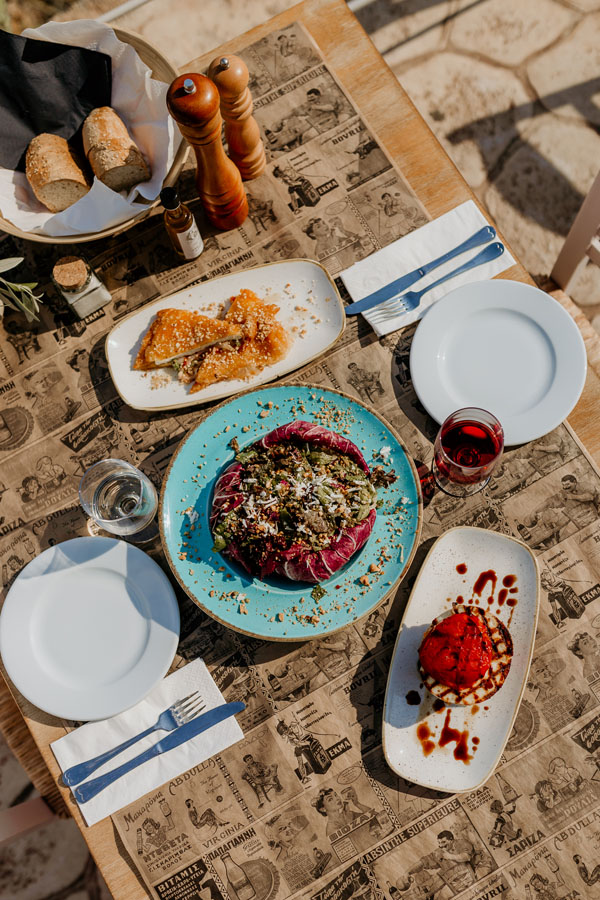
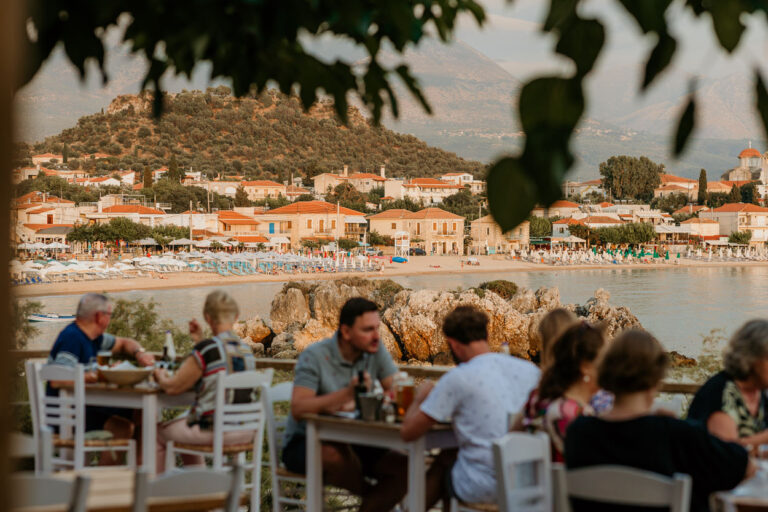
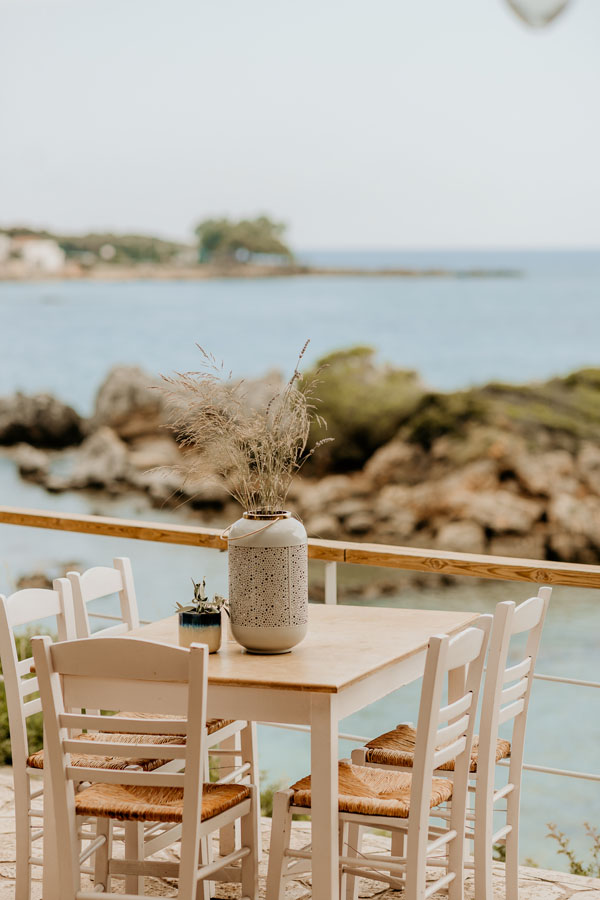
Liastres, traditional Greek restaurant in Stoupa sits on Tampoureas street on the headland at the edge of the bay, looking out over the Messenian Gulf. It is family-run, the ingredients are locally sourced and seasonal, and the menu is rooted in Mani recipes, slow-cooked meats, fresh seafood, handmade pies, moussaka, stuffed vegetables, salads built out of sun-ripened produce, and a list of local wines and spirits. Vegetarian dishes are on the menu too, which in a region this attached to pork is not a given.
Forty metres up the same street, Enigma cafe and cocktail bar in Stoupa handles the other half of the evening, the sunset, and what you drink while it happens.
If you want the wider picture of the village first, the first-timer’s guide to Stoupa covers the beaches and the shape of the place, and there is a longer piece on where to eat in Stoupa.
A short honest note
Not every dish here is on every menu every night. Syglino is seasonal and dependent on who cured it. Lalangia turn up around holidays more than they do in August. Ask. In a village this size the person answering usually cooked it, and would rather tell you what is good today than sell you what is written on the card.
That is, in the end, the whole argument for eating in Mani rather than merely eating in Greece.
Book a table: Liastres, traditional Greek restaurant in Stoupa, reservations by phone; numbers on the contact page.
Mani food questions people ask
What is Mani food?+
The cooking of a dry, rocky peninsula that was poor and cut off for centuries: pork preserved in its own fat and smoked (syglino), strips of dough fried in olive oil (lalagia), wild greens gathered rather than farmed, brined sfela cheese, handmade pies, and olive oil and oranges through almost everything.
What are some traditional dishes from the Peloponnese?+
In the Mani specifically: syglino, lalagia, sfela cheese, kayianas (eggs cooked down with tomato, often with syglino), open cheese pies and diples for celebrations. Across the wider Peloponnese you also meet slow-cooked goat and lamb, fresh fish from the gulfs, and everything built on Kalamata olives and oil.
What does Mani mean?+
Mani is the name of the middle peninsula of the southern Peloponnese, between the Messinian and Laconian gulfs, and of the fiercely independent people who lived in its tower villages. The origin of the word is debated; the medieval Franks called it Maina, and the many-towered land was known as Maina Polypyrgos.
What is a typical Greek lunch?+
In a Mani taverna, lunch is shared plates: a salad with local oil, something from the sea or the oven, a plate of greens, bread and a carafe of local wine, eaten slowly in the early afternoon. Big single-plate meals are a tourist habit; sharing is the local one.
What time do Greeks eat dinner?+
Late. In summer most Greek tables fill from nine in the evening onward, after the sunset, and go on for hours. In Stoupa that means a swim, a shower, a sunset drink at Enigma and then dinner at Liastres when the terrace has cooled down. Tourists eat earlier, which is why early tables are easier to get.
How is syglino eaten?+
Sliced thin as a meze with tsipouro or wine, cooked through kayianas with eggs and tomato, folded into pies, or stirred through pasta. It is seasonal and depends on who cured it, so ask what the kitchen has that day.
Where can I eat Mani cuisine in Stoupa?+
At Liastres, the family-run traditional Greek restaurant on Tampoureas street, whose menu is rooted in Mani recipes: syglino, lalagia, slow-cooked meats, fresh fish from the gulf, handmade pies and salads from the gardens above the village, with local wines and spirits. Portions are made for sharing.
Read next
All journal articles · Enigma & Liastres Stoupa · Book a table
Comment
[…] salt, fat and acidity. In the Mani the classic spread writes itself, and most of it is exactly what our guide to Mani cuisine tells you to eat […]