Coffee in Greece is not a quick stop on the way somewhere else. It is the reason to sit down. A single cup can stretch across an hour of conversation, a card game, or a long look at the sea, and nobody will hurry you. If you are visiting Stoupa and want to drink coffee the way the locals do, this guide explains the drinks you will see on every menu, from the old ellinikos boiled in a briki to the freddo espresso that has become the national summer drink, and how to order each one the way a Greek would. At Enigma cafe and cocktail bar in Stoupa, on the headland at the edge of the bay, the day runs from that first coffee to the last cocktail, so it is a natural place to practise.
Key takeaways
- Greek coffee (ellinikos) is finely ground coffee boiled with water in a briki, unfiltered, served small and strong in taste.
- Freddo espresso is a double espresso shaken with ice, black; freddo cappuccino is the same with cold frothed milk on top.
- Frappé is the older cold drink: instant coffee shaken to a foam with water and ice, sweet if you want it.
- Order sweetness with the coffee: sketos (no sugar), metrios (one spoon), glykos (two).
- A Greek coffee has less caffeine per cup than an espresso; a freddo, being a double shot, has the most.
- In Stoupa, Enigma serves coffee, freddo and frappé all day on the terrace over the Messenian Gulf.
What Greek coffee actually is
Ellinikos kafes, plain Greek coffee, is the drink that older Greeks still mean when they say the word coffee. It is arabica beans roasted light and ground to a powder finer than espresso grind, then cooked with cold water, and sugar if wanted, in a small long-handled pot called a briki. The pot goes over low heat until a thick foam, the kaimaki, rises to the rim. The coffee is poured foam first into a demitasse and left to sit for a minute so the grounds settle. You drink it slowly and stop before the sludge at the bottom, which is where the fortune tellers of the old kafeneia found their material.
The method is the same one used across the eastern Mediterranean and the Balkans, and yes, the drink is essentially what other countries call Turkish coffee. In Greece the name changed in the 1960s and the name stuck. What makes a good ellinikos is patience: low heat, no stirring once it starts to rise, and a thick unbroken kaimaki on top. A cup with no foam is a cup made in a hurry.
How Greek coffee differs from a regular coffee
Three things set it apart from the filter coffee most northern European visitors drink at home. First, it is unfiltered, so the body is thick and the flavour is round and slightly chocolatey rather than bright. Second, the sugar goes in during brewing, so the drink is sweetened evenly and you cannot adjust it afterwards. Third, the portion is small, a demitasse of roughly 60 ml, and it is always served with a glass of cold water. You sip the water first to clear the palate, then the coffee.
The caffeine question surprises people. Because the roast is light and the cup is small, a Greek coffee delivers around 40 to 60 mg of caffeine, less than a single espresso shot at 60 to 80 mg and far less than a large filter coffee. It tastes strong because it is dense, not because it is loaded. This is one reason the elderly residents of Ikaria, studied for their longevity, could comfortably drink two or three a day.
Freddo espresso: the drink that took over Greece
Walk into any Greek cafe in summer and the drink in most hands is a tall glass of black coffee over ice with a fine foam on top. That is the freddo espresso, and it is a Greek invention from the early 1990s, not an Italian one. The recipe is simple to say and hard to do well: a double shot of espresso, pulled fresh, goes into a shaker or a blender with a few ice cubes and is shaken hard until it cools and foams. It is then poured over more ice into a tall glass. Sugar, if you want it, is added before shaking so it dissolves.
The result is intensely aromatic, cold to the last sip, and stronger than most people expect because it is a double shot. The word freddo simply means cold in Italian, and Italians will look at you blankly if you order one in Rome. In Greece it is as standard as a beer.
Freddo cappuccino: the same coffee with a cloud on top
The freddo cappuccino starts identically, a double espresso shaken with ice, and then adds a thick layer of cold frothed milk, sometimes with a dusting of cinnamon or cocoa. It is creamier, milder and a little sweeter, and it is the choice of most people who would order a latte at home. A good one has milk foam dense enough to hold its shape for several minutes rather than collapsing into the coffee. If you want it with less milk, ask for it with ligo gala; if you want oat or almond milk, most cafes in tourist villages like Stoupa now keep them.
Frappé: the original Greek cold coffee
Before freddo there was frappé, born in Thessaloniki in 1957 when a Nescafé representative at a trade fair had no hot water and shook instant coffee with cold water and ice instead. The foam that formed became a national institution. A frappé is instant coffee, sugar to taste and a little water shaken or whisked to a stiff foam, then topped with cold water, ice and, if you like, milk. It is lighter in flavour than freddo, cheaper, and it lasts. A frappé nursed on a beach lounger over two hours is one of the defining images of a Greek summer, and you will still see plenty of them on the sand below Enigma in Stoupa.
How to order coffee like a Greek
Greeks order the coffee and the sweetness in one breath, and the sweetness words are the same for every drink:
- Sketos: no sugar.
- Metrios: medium, about one teaspoon of sugar.
- Glykos: sweet, about two teaspoons.
- Me gala: with milk. Horis gala: without.
So a Greek coffee with one sugar is an ellinikos metrios. A cold black double espresso with no sugar is a freddo espresso sketos. A frappé with milk and two sugars is a frappé glykos me gala. Say ena, meaning one, in front and you are done. If you forget everything else, remember that the sweetness is decided at the counter, not at the table, because for ellinikos and freddo the sugar is worked into the drink while it is made.
Two more habits worth copying. The glass of water that arrives with every coffee is not a mistake, drink it. And nobody is expected to leave when the cup is empty; the coffee buys the seat for as long as you want it.
Where to drink it in Stoupa
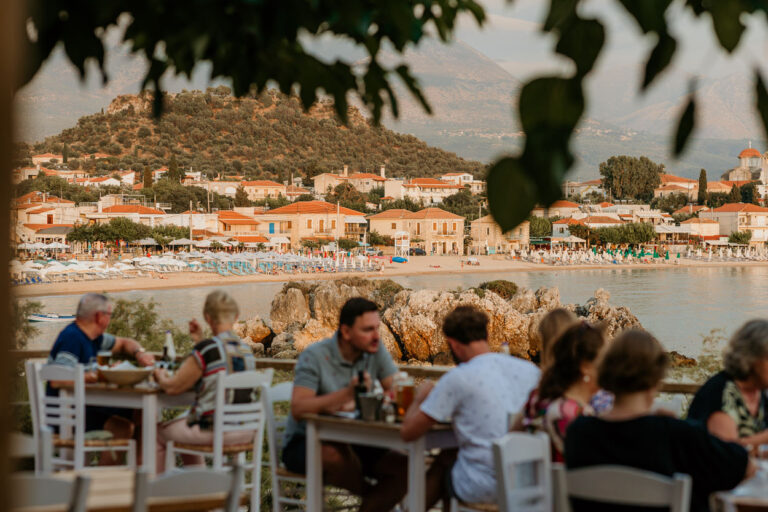
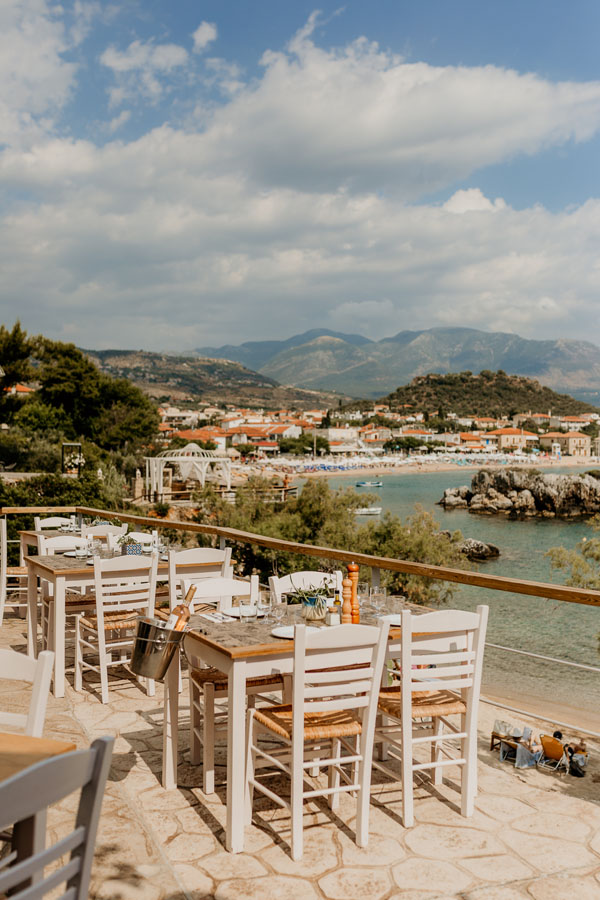
Enigma, the cafe and cocktail bar on Tampoureas street, sits on the headland at the right hand edge of Stoupa bay with the terrace looking west across the Messenian Gulf. The coffee list covers the full Greek range, espresso and ellinikos, freddo espresso and freddo cappuccino, frappé, plus iced drinks, beer and light bites through the day, and the same terrace turns into the sunset cocktail bar in the evening. The stretch of beach below belongs to the venue, so the classic Stoupa rhythm is a swim, a freddo on the terrace, and back to the water. Later in the day, Liastres, the traditional Greek restaurant 40 metres along the same street, does the food side of the same idea, and after dinner a Greek coffee there is the proper full stop to a Mani meal.
If you are staying a while, our guide to sunset cocktails and Greek spirits covers what comes after the coffee, and the guide to Mani cuisine covers what to eat in between.
Practical notes
- Greek coffee: about 60 ml, 40 to 60 mg caffeine, always with water, sugar decided when ordering.
- Freddo espresso: double shot, black, over ice; freddo cappuccino: the same with cold milk foam.
- Frappé: instant coffee, foam, ice, optional milk; the lighter, longer drink.
- Sweetness words: sketos, metrios, glykos. Milk: me gala.
- In Stoupa: Enigma on Tampoureas street, terrace over the gulf, coffee through the day, cocktails at sunset. Contact and directions.
Greek coffee questions people ask
What is in a Greek coffee?+
Traditional Greek coffee is only two things: very finely ground arabica coffee and water, boiled together slowly in a small long-handled pot called a briki. Sugar is added during brewing if you want it, never after. Nothing is filtered out, so the grounds settle at the bottom of the cup and you stop drinking just above them.
Is Greek coffee stronger than espresso?+
Per cup, no. A demitasse of Greek coffee has roughly 40 to 60 mg of caffeine, while a single espresso shot usually carries 60 to 80 mg. Greek coffee tastes intense because it is unfiltered and thick, but espresso is the stronger drink by caffeine. A freddo espresso is a double shot, so it is stronger than both.
What is the difference between freddo espresso and freddo cappuccino?+
Both start with a double espresso shaken or blended with ice until it foams. A freddo espresso stops there, black and cold. A freddo cappuccino adds a layer of cold frothed milk on top, so it is creamier and milder. Order the espresso if you want the coffee flavour clean, the cappuccino if you like milk.
Is freddo espresso stronger than regular espresso?+
Yes, because it is made with a double shot. The ice dilutes it a little as it melts, but you are still drinking two shots of espresso, which is why one freddo in the afternoon can keep you going until the sunset cocktail. If you want something lighter, ask for a single shot or choose a freddo cappuccino.
Is Greek coffee healthier than regular coffee?+
Greek coffee is unfiltered and lightly roasted, so it keeps more of the natural compounds of the bean, and it is served in a small cup with relatively little caffeine. Studies on the island of Ikaria linked daily boiled coffee to good vascular health in older people. It is not a medicine, but drunk plain and in moderation it is one of the gentler ways to take coffee.
How to ask for coffee in Greece?+
Say the coffee, then the sweetness. Sketos means no sugar, metrios means medium with one spoon, glykos means sweet with two. So a freddo espresso metrios is a cold double espresso with one sugar, and an ellinikos sketos is a plain Greek coffee. Add ena, meaning one, at the start and you sound like a regular.
Is Freddo espresso better than frappé?+
They are different drinks for different moods. Frappé is instant coffee shaken with water and ice, foamy, sweet if you want it, and the taste of Greek summers since the 1950s. Freddo espresso is fresh espresso over ice, more aromatic and less sweet. Most Greeks under forty now order freddo, but frappé still has loyal fans, especially by the beach.